
Emergency Alerting and Mass Notification Systems
GDS designs emergency alerting systems for military airbases, commercial airports, and municipal facilities. These systems provide continuous monitoring and notifications to help personnel coordinate an emergency response.
Aircraft Crash Alerting Systems
Our crash alerting systems connect the control tower with emergency responders during aircraft incidents. For Fort Campbell, Kentucky, which runs both Campbell Army Airfield and Sabre Army Heliport, GDS designed and installed a system that:
- Sends alerts from the control tower to fire stations, hospitals, and first responders during aircraft emergencies.
- Provides real-time visual confirmations of alert acknowledgments and responder mobilization.
- Integrates Motorola ACE3600 RTUs with custom applications, licensed radio networks (Motorola MOTOTRBO/ASTRO IV&D), and operator interfaces for coordinating emergency response.
At Fort Campbell, a crash button at any of four master stations, in the Campbell and Sabre towers and operations centers, sets off the alarm at every station. Acknowledgment lights on each master panel show which responder stations have answered. GDS services the network, most recently in 2024.
Alarm Monitoring and Mass Notification
GDS provides alarm monitoring and mass notification systems for government and military installations. Our alarm monitoring systems use Motorola ACE3600 RTUs and ASTRO digital trunked radio for remote-to-remote communications and real-time data collection from alarm panels, water tanks, and pump stations. Redundant equipment and automatic failover support continuous operation. Wonderware screens give operators a central view of alarms, sensor events, and equipment status.
Alarm monitoring brings equipment and sensor conditions back to the operator. Mass notification sends instructions or warnings out to selected areas. We define those functions separately so the required field inputs, notification zones, and operator controls are clear during design and testing.
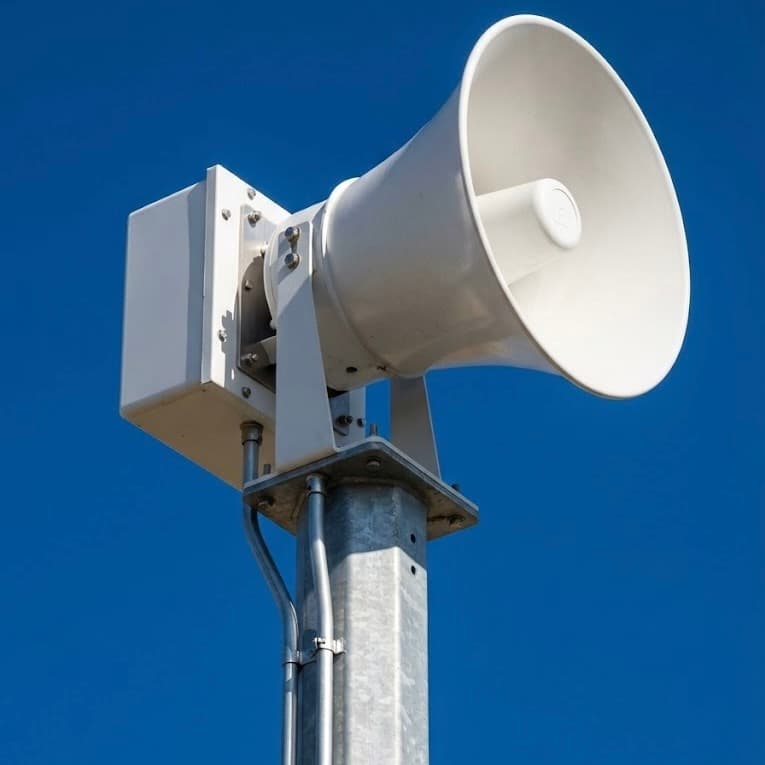
Mass notification systems use SCADA-controlled public address equipment, sirens, and strobes. Distributed controls, pushbuttons, or handheld microphones allow personnel to activate specific zones, with HMI integration where required. GDS provides RTU installation, siren wiring, and training for systems used in emergencies and drills.
Emergency System Integration and Support
We work with customers to select the controls, communications, and support needed for their emergency systems.
- Engineering experience: Control system design for defense, aviation, and municipal applications.
- System integration: Motorola RTUs, ASTRO radio networks, and third-party equipment configured for the application.
- Technical support: Design, FCC licensing, installation, maintenance, and training.
Commissioning checks the field connections, operator indications, and notification controls against the agreed requirements. Training covers system operation and drills, with documentation available for subsequent maintenance.
Common Questions
- How do crash alerting and mass notification differ?
- Crash alerting connects an initiating station, such as a control tower, with designated responders and their acknowledgment indications. Mass notification activates selected speakers, sirens, strobes or other notification equipment. The design identifies the required stations, zones and operator controls for each function.
- Can an existing radio network be used?
- We review the installed radio system, interfaces, coverage and owner requirements before deciding what can be retained. We also check controller compatibility, message behavior and how a failed connection is shown.
- What should be included in a request for an alerting system?
- Provide the initiating and receiving locations, notification zones, existing controllers and radios, site drawings and the required operating sequence. Include any access restrictions and requirements for redundant equipment or communications so they can be addressed in the scope.
- How is the system tested before handover?
- Acceptance checks follow the agreed operating requirements. They can cover initiation, selected-zone activation, station acknowledgments, operator indications, communication failures and recovery. Training and drills are planned with the owner's staff; installed equipment supports their emergency procedures.
Related Insights
Communications
Radio Network Design for SCADA →
Design reliable radio networks for SCADA communications with proper path analysis and signal validation.
Motorola SCADA
Motorola ACE3600 Integration Services →
Planning ACE3600 integration, including MOSCAD migration, system changeover, and ongoing support.
HMI and Software
SCADA Alarm Rationalization and Priorities →
How to rationalize SCADA alarms so operators get fewer nuisance alarms and faster response to real events.
Contact GDS About Your SCADA System
Send a site list, a part number or a description of the problem, and we'll reply with next steps and a rough scope.
Email Us
Contact us at sales@gbl-data.com
Call Us
Discuss your project with our team at 480-461-3401
Visit Us
Find our main office at 1815 W 1st Ave #110, Mesa, AZ 85202